


Three years ago, when we were designing the core platform architecture for Corvenia (Corvenia.Yggdrasil), we had to make a foundational choice: what UI platform should sit on top of our .NET backend?
The conventional industry playbook was obvious: build an ASP.NET Core Web API backend in C#, and pair it with a separate React + TypeScript Single Page Application (SPA) in the browser. React had the largest component ecosystem and the deepest pool of public training data.
Instead, we weighted our architectural evaluation around a forward-looking question: What happens when AI coding agents take over the bulk of day-to-day implementation? We wanted an architecture with the fewest independent sources of truth, the strongest end-to-end type enforcement, and the tightest possible compiler verification loop.
We chose Blazor Server on top of ASP.NET Core. Three years later, that decision has proven to be one of our highest-leverage engineering bets. Recently, I had a long architectural deliberation with an AI research assistant dissecting why this delta between Blazor Server and React + Web API matters so much for autonomous coding agents. Here is a look inside that weighting—and why machine-verifiable correctness beats raw ecosystem size in the AI era.
1. Code Generation vs. Code Verification
When people compare frameworks for AI-assisted development, they usually focus on how easily a model can generate a snippet of code. Historically, React had more training examples on GitHub, whereas Blazor had a smaller ecosystem.
Today, two things have changed:
- Frontier models are fluent in Razor and MudBlazor: Tools like Claude Code (
claude), OpenAI Codex (codex), and Google Antigravity (agy) generate idiomatic Razor components and MudBlazor layouts effortlessly. Even better, because AI can generate bespoke UI components on demand, Blazor's smaller third-party widget ecosystem is no longer a bottleneck. - Verification is now the true bottleneck: As AI agents move from autocompleting single functions to building entire vertical features autonomously, we must distinguish between how easily AI can generate code and how reliably we can verify the generated code.
The Verification Principle: AI coding performance depends far more on how much of an application's correctness is machine-verifiable than on how fast the AI can emit tokens.
When we compare .NET + Blazor Server against .NET + React, any shared backend concerns (like database schema design) cancel out. What matters is the architectural delta between the database layer and the pixels on screen.
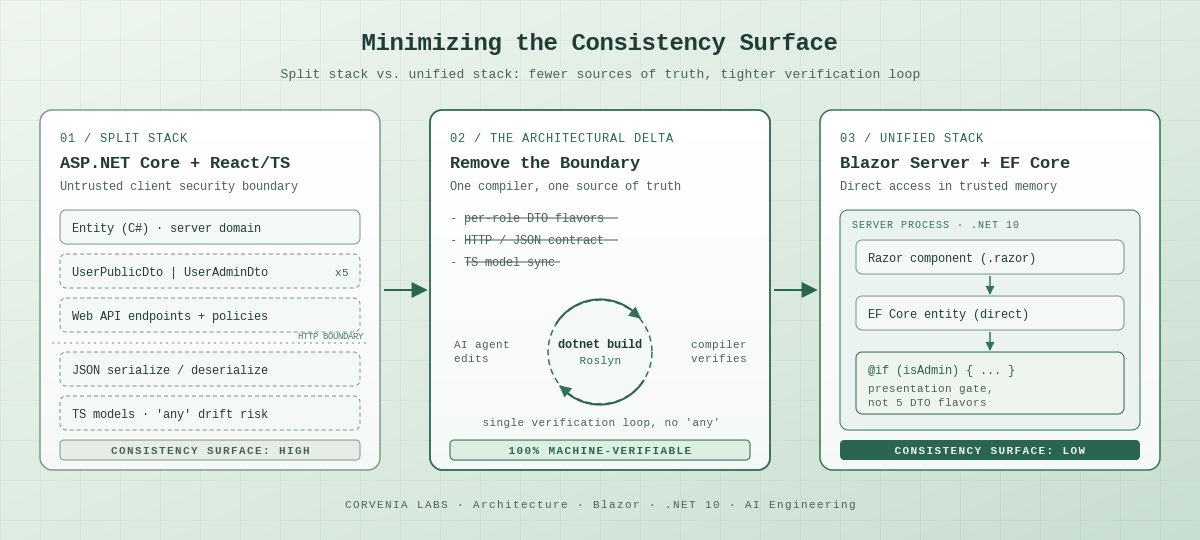
2. Eliminating the Untrusted Wire Boundary & "DTO Explosion"
In a traditional .NET + React architecture, the browser is an untrusted client. Every piece of data displayed in the UI must cross an HTTP network boundary as serialized JSON.
Consider what that security boundary forces you to build for a seemingly simple User or LegalEntity Entity Framework (EF) Core model. An EF User entity in the database might contain Username, FirstName, LastName, Email, DateOfBirth, PasswordHash, SecurityStamp, and internal tenant audit metadata.
Because you cannot serialize the EF entity over a Web API to a React client without leaking sensitive fields in the browser's network tab, you are forced to create stripped-down Data Transfer Objects (DTOs). Worse yet, because what a user is allowed to see or edit depends on their permission level and the specific view, a single domain concept splinters into five or more DTO flavors:
UserPublicListingDto(for standard users viewing a directory)UserProfileDetailDto(for a user viewing their own profile)UserAdminManagementDto(for tenant administrators)UpdateUserProfileRequestDto(for inbound mutations from a regular user)AdminUpdateUserRequestDto(for inbound mutations from an admin)
For every single one of those flavours, an AI agent working in a React + Web API codebase must maintain:
- The C# Entity Framework model
- Multiple per-role C# Response and Request DTOs
- Bidirectional mapping logic (Entity ↔ DTOs) and per-endpoint authorization filters
- The Web API controller / Minimal API endpoints and OpenAPI annotations
- The TypeScript interfaces (
interface UserAdminManagementDto) and client-side state/validation schemas
We call the number of independently maintained representations that must agree for the application to work the consistency surface.

How Blazor Server Collapses the Boundary
In Blazor Server, component execution, Entity Framework Core, and application services all run inside trusted server memory. The underlying entity is never serialized to the browser—only the rendered DOM diff travels over the circuit.
@* Blazor Server: The EF entity never crosses the wire to the browser.
   Field visibility is a clean presentation & authorization gate, not 5 separate DTO contracts. *@
@inject IUserAuthorizationService AuthService

<div class="user-card">
    <div class="heading-h5">@UserEntity.FirstName @UserEntity.LastName</div>
    <div class="subtext-s2 mono-text">@UserEntity.Username</div>

    @if (IsAdminViewer)
    {
        <div class="admin-metadata-box">
            <span>Birth Date: @UserEntity.DateOfBirth?.ToString("yyyy-MM-dd")</span>
            <span>Last Audit: @UserEntity.LastSecurityReviewUtc</span>
        </div>
    }
</div>

@code {
    [Parameter, EditorRequired]
    public required ApplicationUser UserEntity { get; set; }

    [Parameter]
    public bool IsAdminViewer { get; set; }
}
Instead of becoming a data-modeling and serialization problem requiring five DTOs, ten mapping methods, and five TypeScript interfaces, role-based field visibility becomes a straightforward server-side presentation and authorization problem. You still enforce authorization on queries and mutations on the server (which you must do in any architecture), but you eliminate the entire client-facing HTTP API, the DTO explosion, and the wire serialization layer.
For an autonomous AI coding agent, removing that boundary doesn't just save lines of boilerplate—it eliminates an entire category of cross-layer integration defects.
3. Why C# Compiler Enforcement Beats Permissive TypeScript in Practice
A fair counterargument that came up in our deliberation is: "Wait—doesn't TypeScript give React compile-time type safety too? And can't you use OpenAPI code generators to sync C# and TypeScript models?"
In theory, yes. TypeScript has a very expressive structural type system. In practice, however, when you watch how LLMs and coding agents actually write and refactor code across a large enterprise repository, three critical differences emerge:
- AI Models Default to Common Training Priors: Unless heavily policed, LLMs generating TypeScript frequently fall back to the path of least resistance found in millions of public repositories—using permissive types,
any, loose object literals,as unknown as Ttype assertions, or JavaScriptnumber(IEEE-754 float) for financial quantities that require 128-bitdecimalprecision. - TypeScript Types Are Erased at Runtime: Even when
tscpasses, TypeScript's compiler cannot verify the underlying C# implementation across the HTTP seam without external codegen pipelines running in lockstep. - C# Forces the AI Into Strict Correctness: In a
.NET 10solution configured with<Nullable>enable</Nullable>and<TreatWarningsAsErrors>true</TreatWarningsAsErrors>, the AI agent cannot cheat. It cannot pass adecimalinto alongminor-unit field, forget to handle a null reference, or invent a property on a Razor component parameter without Roslyn immediately rejecting the build.
namespace Corvenia.Ledger.Contracts;

// In C#, the AI is forced by the compiler to respect exact value semantics
public readonly record struct MonetaryAmount(long MinorUnits, CurrencyCode Currency)
{
    public decimal ToDecimal() => MinorUnits / 100m;
}
4. The Autonomous Agent Verification Loop
Think about how an autonomous coding agent (agy, claude, or codex) works when given a task:
- Edit the domain model, service, and UI component.
- Compile the solution and read compiler diagnostics.
- Repair any broken references and repeat until clean.

Let's compare the architectural delta across our key scenarios:
| Architectural Dimension | ASP.NET Core API + React / TypeScript | ASP.NET Core + Blazor Server (Unified) |
|---|---|---|
| Client-Facing Wire Boundary | Untrusted browser receives raw JSON payloads | Trusted server execution; only DOM diffs sent |
| Per-Permission Data Shaping | Requires multiple DTO flavors & mappers per role | Direct server-side conditional rendering (@if) |
| Independent Contracts to Sync | EF Entity → DTOs → Controller → OpenAPI → TS → React | EF Entity / Domain Service → Razor Component |
| Compiler Coverage | Split (dotnet build + tsc) with a network gap |
100% unified under a single Roslyn dotnet build |
| LLM Escape-Hatch Risk | High (any, type erasure, float rounding drift) |
Locked down by C# nominal types & analyzers |
Where We Still Stay Vigilant
Of course, a C# compiler check is not a silver bullet for every possible bug. As we noted in our deliberations, there are specific areas in Blazor where human and AI reviewers must stay disciplined:
- Pre-.NET 8/10 Training Drift: Older LLM training data sometimes mixes legacy
.NET 6/7hosting models (_Host.cshtml) with modern.NET 8/10Blazor Web App conventions. We solve this with explicit repository rules (CLAUDE.md/ Antigravity rules) that pin our exact component and lifecycle patterns. - DbContext Lifetimes & Server Authorization: Because Blazor Server components live across persistent SignalR circuits, we use
IDbContextFactory<T>for deterministic unit-of-work lifetimes and enforce strict server-side permission checks on every command handler—never relying solely on hidden UI buttons for security.
Conclusion: Betting on Machine-Verifiable Simplicity
Three years ago, choosing Blazor over React felt contrarian to developers who measured frameworks purely by npm download counts. Today, in an engineering culture where AI agents write, refactor, and verify massive vertical slices of our platform every day, the wisdom of that choice is unmistakable:
For AI-generated, server-centric business applications, Blazor Server reduces the number of independently maintained representations, integration boundaries, and cross-language consistency obligations—dramatically reducing integration defects and repair iterations for autonomous coding agents.
By collapsing the consistency surface into a single language, a single memory boundary, and a single deterministic compiler, we let both our engineers and our AI agents focus 100% of their intelligence on solving multi-entity financial problems—rather than maintaining glue code between two ecosystems.
